SMS Bomber
SMS Bomber – Complete Guide to SMS Bombing, Security, and Protection
An SMS bomber is a tool or script designed to send a large number of SMS messages or OTP requests to a single mobile number within a short period. While many people search for an SMS bomber out of curiosity, understanding how it works, the risks involved, and the available security measures is far more valuable than attempting to use one. Modern businesses, banks, and online platforms rely heavily on SMS verification, making SMS abuse a serious cybersecurity concern. This guide explains the technology behind an SMS bomber, compares it with ordinary spam, discusses security risks, and provides practical ways to protect yourself from message flooding attacks.
📱 SMS Bomber (Prank Simulator)
What Is an SMS Bomber?
An SMS bomber is software that repeatedly triggers SMS messages to a target phone number by exploiting websites, mobile applications, or APIs that automatically send verification messages. Instead of sending traditional text messages directly, many SMS bomber tools continuously request OTPs, promotional codes, or verification messages from multiple online services.
Unlike regular messaging applications, an SMS bomber automates the process through scripts or bots. Within minutes, the target may receive dozens or even hundreds of SMS notifications, making the phone difficult to use normally.
Although many websites advertise free SMS bomber tools, using them against someone else's number without permission may violate the terms of service of online platforms and applicable laws. For this reason, cybersecurity professionals recommend learning about SMS bombing only for awareness and defensive purposes.
How SMS Bombing Works
An SMS bomber generally operates by automating repeated requests instead of manually sending messages. Many online services automatically send an SMS whenever a user requests account verification, password recovery, or login authentication. Attackers exploit these automated systems by repeatedly submitting the victim's phone number.
A typical SMS bombing process follows these stages:
The attacker enters a target phone number.
The script contacts multiple websites or SMS APIs.
Each service sends a verification or OTP message.
The requests repeat rapidly using automation.
The victim receives an overwhelming number of SMS notifications.
Modern SMS bomber scripts often include support for multiple public APIs, allowing them to generate messages from many different services instead of relying on a single provider. However, reputable platforms now implement advanced rate limiting, CAPTCHA verification, device fingerprinting, and behavioral analysis to reduce this type of abuse.
If you are researching SMS Bomber Risks or learning about security, understanding this workflow helps explain why many platforms continuously improve their verification systems.
SMS Bombing Risks
Using or becoming the target of an SMS bomber creates several security and privacy concerns. Although message flooding may initially appear to be a harmless prank, the consequences can be much more serious.
One of the biggest risks is notification overload. Hundreds of incoming messages may prevent users from noticing genuine OTPs from banks, payment services, or business accounts. Important authentication codes can easily become buried beneath unnecessary notifications.
Another concern involves denial of communication. Continuous message alerts may slow down older devices, reduce battery life, and make it difficult to identify legitimate calls or text messages.
Organizations also suffer financial losses because every SMS verification request costs money. Large-scale SMS bomber attacks can significantly increase operational expenses for businesses that depend on SMS authentication.
Additional risks include:
Increased infrastructure costs for service providers.
Disruption of customer authentication systems.
Temporary blocking of legitimate OTP requests.
User frustration and reduced trust in online platforms.
Potential misuse during social engineering attacks.
Learning about SMS Bomber Security Guide topics helps users recognize these risks before they become victims.
SMS Spam vs SMS Bombing
Although many people confuse SMS spam with SMS bombing, they are different types of communication abuse.
SMS spam focuses on delivering unwanted advertisements, phishing links, or promotional content to many recipients. The objective is usually marketing, fraud, or data theft.
An SMS bomber, however, targets one specific phone number with an extremely high volume of messages. The goal is to overwhelm the recipient rather than advertise products.
| SMS Spam | SMS Bombing |
|---|---|
| Promotional or phishing messages | Large volume of verification messages |
| Usually sent to many recipients | Usually targets one individual |
| Focuses on marketing or scams | Focuses on flooding notifications |
| Individual messages | Hundreds of repeated requests |
| Often contains suspicious links | Usually consists of OTPs or verification texts |
Understanding this distinction helps explain why security experts treat SMS bombing as a denial-of-service style attack rather than ordinary spam.
How to Protect Yourself
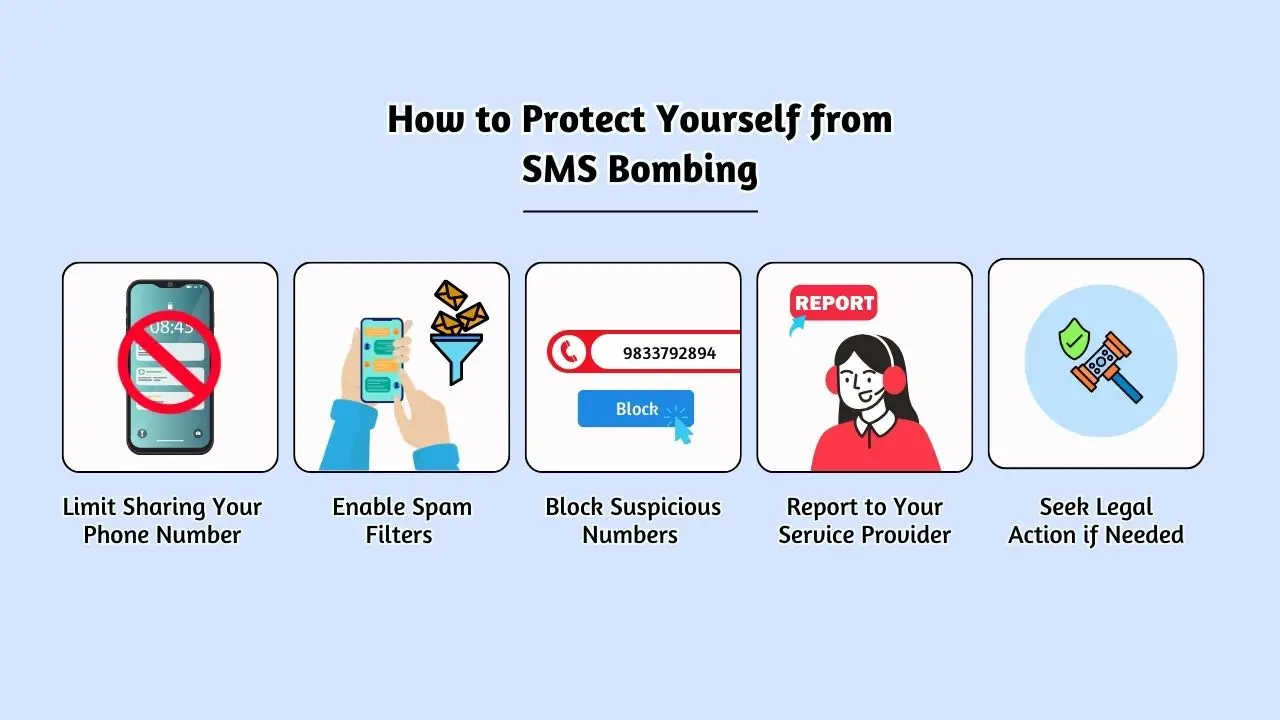
Protecting yourself from an SMS bomber starts with reducing unnecessary exposure of your phone number. While no solution is perfect, combining several security practices greatly lowers the chances of becoming a target.
Avoid sharing your number publicly on social media, forums, or untrusted websites. Many attackers collect phone numbers from publicly available sources before launching automated attacks.
Enable spam filtering features offered by your mobile operating system or mobile carrier. Many smartphones can automatically identify suspicious senders and reduce notification clutter.
Other effective protection strategies include:
Keep your mobile operating system updated.
Use strong account passwords.
Enable two-factor authentication where available.
Report repeated abuse to your mobile carrier.
Block suspicious numbers whenever possible.
Avoid entering your phone number on unknown websites.
Following these practices provides better protection than relying on any single security tool.
OTP Security Guide
One of the most common objectives behind an SMS bomber is disrupting One-Time Password (OTP) delivery. OTP messages play a critical role in user authentication, password recovery, and financial transactions.
To improve OTP security, organizations implement multiple defensive mechanisms instead of depending solely on SMS verification.
These include CAPTCHA challenges, behavioral analysis, request throttling, IP reputation systems, and temporary account restrictions. Many platforms also offer authentication applications or passkeys as more secure alternatives to SMS-based verification.
Users should never share OTP codes with anyone, regardless of the reason provided. Banks, government agencies, and legitimate companies will never ask customers to reveal their verification codes through phone calls or text messages.
Reading an OTP Security Guide alongside information about SMS bombing helps users understand why secure authentication methods are becoming increasingly important.
SMS Gateway Security
Every SMS message sent by an application typically passes through an SMS gateway before reaching the recipient's mobile network. Because gateways process millions of messages daily, they include multiple security mechanisms to prevent abuse.
Modern SMS gateway providers monitor unusual traffic patterns and automatically block excessive requests originating from suspicious IP addresses or automated scripts.
Common SMS gateway security features include:
Request authentication.
API key validation.
Traffic monitoring.
Geographic filtering.
IP reputation analysis.
Automated abuse detection.
Message rate control.
Logging and audit systems.
Organizations that properly configure their SMS gateways dramatically reduce the effectiveness of automated SMS bomber attacks.
Rate Limiting Explained
Rate limiting is one of the most effective defenses against an SMS bomber. It controls how many requests a user, IP address, or device can send within a specific period.
For example, a website may allow only three OTP requests every ten minutes. Once the limit is reached, additional requests are temporarily blocked until the waiting period expires.
Rate limiting protects infrastructure, reduces operating costs, prevents automated abuse, and improves service availability for legitimate users.
Developers often combine rate limiting with CAPTCHA verification, behavioral analysis, session validation, and device fingerprinting to create multiple layers of protection against automated attacks.
Without proper rate limiting, even simple automation scripts could generate thousands of unnecessary verification requests within minutes.
SMS API Guide
Many developers use SMS APIs to integrate verification messages, appointment reminders, transaction alerts, and customer notifications into their applications. An SMS API provides a secure interface that allows software to send messages through trusted SMS providers.
Responsible API providers implement several security controls designed to prevent abuse associated with SMS bomber activity.
Developers should follow these best practices:
Protect API keys securely.
Enable authentication for every request.
Validate phone number formats.
Monitor unusual traffic patterns.
Apply rate limiting to all endpoints.
Log suspicious activity.
Rotate API credentials regularly.
Restrict access by IP address where possible.
Following these practices not only improves application security but also helps reduce fraudulent message requests and infrastructure abuse.

FAQ's
Is an SMS bomber illegal?
Legality depends on local laws and how the tool is used. Using an SMS bomber to intentionally disrupt someone else's communications may violate laws or service terms.
Can SMS bombing steal personal data?
An SMS bomber itself generally floods a phone with messages rather than stealing information. However, attackers may combine message flooding with phishing or social engineering attacks.
Can businesses stop SMS bombing?
Yes. Businesses reduce abuse using CAPTCHA verification, rate limiting, SMS gateway protection, API authentication, and behavioral monitoring.
Does changing my phone number prevent SMS bombing?
Changing your number may stop attacks against the old number, but it is usually better to report abuse to your mobile carrier and strengthen your account security first.
What is the safest way to protect OTP messages?
Use trusted services, enable additional authentication methods when available, never share verification codes, and keep your accounts secured with strong passwords and updated devices.
Conclusion
Understanding how an SMS bomber works is essential for anyone interested in digital security, online privacy, or secure authentication systems. While message flooding tools continue to evolve, organizations now defend against them through CAPTCHA verification, intelligent monitoring, SMS gateway protection, API security, and rate limiting. Users can also reduce their risk by protecting their phone numbers, avoiding suspicious websites, and following strong authentication practices. Learning about SMS bombing from a security perspective helps create safer online services while encouraging responsible use of modern communication technology.
Comments
Post a Comment